What Is RCS Messaging? Why Businesses Are Switching from SMS
RCS messaging is replacing SMS for enterprise communications. Learn what it is, how it works, and why businesses are switching to branded, interactive messaging.

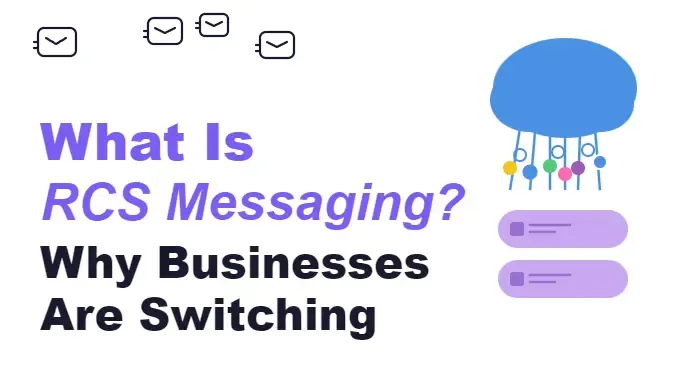
RCS messaging short for Rich Communication Services is the next generation of business text messaging. It delivers branded, interactive messages with images, videos, action buttons, and read receipts, all within the native messaging app on a user's phone. No app download required.
For businesses that rely on SMS to reach customers, RCS is the most significant upgrade available today. Same delivery infrastructure, dramatically better experience and the numbers are starting to prove it.
What Is RCS Messaging?
RCS (Rich Communication Services) is a messaging protocol developed to replace traditional SMS. It was standardized by the GSM Association (GSMA) and is now supported by Google on Android and, as of September 2024, by Apple on iOS 18.
Where SMS is limited to 160 characters of plain text, RCS supports:
- High-resolution images and video
- Carousels and suggested reply buttons
- Branded sender identity: your logo and business name
- Read receipts and typing indicators
- Verified sender status to prevent spoofing
- Unlimited message length
From the customer's perspective, an RCS message looks closer to a WhatsApp or iMessage conversation than a traditional SMS. From the business's perspective, it performs significantly better.
Yootelco offers fully managed RCS Messaging with verified sender setup and automatic SMS fallback included.
RCS by the Numbers: Why It's Growing Fast
RCS is no longer an emerging technology - it has crossed into mainstream adoption. Here's what the latest data shows:
- Over 1 billion RCS messages are sent daily in the US alone (Google, May 2025)
- RCS business messaging traffic grew 311% globally in 2025 (Infobip)
- The global RCS market was valued at $2.87 billion in 2025 and is projected to reach $10.93 billion by 2031 a 25% CAGR (Mordor Intelligence)
- Apple's iOS 18 RCS support triggered a 500% spike in global RCS traffic immediately after launch
- RCS for Business is now available in 57 countries, powered by Google's infrastructure
- Open rates for RCS campaigns reached 53% during the 2024 holiday season (Sinch)
The trajectory is clear. Businesses that deploy RCS now are positioning themselves ahead of the curve not chasing it.
RCS vs SMS Side-by-Side Comparison
| Feature | SMS | RCS |
|---|---|---|
| Character limit | 160 characters | Unlimited |
| Rich media | No | Images, video, carousels |
| Branded sender | No | Yes — logo + name |
| Read receipts | No | Yes |
| Interactive buttons | No | Yes |
| Delivery without internet | Yes | No (requires data) |
| Global reach | Universal | Growing — 57+ countries supported |
| Fallback to SMS | N/A | Yes, automatic |
The key practical point: RCS does not replace SMS entirely. When a device or carrier does not support RCS, messages automatically fall back to SMS. Businesses can deploy RCS without losing any reach they simply deliver a richer experience wherever it's supported.
Why Are Businesses Switching to RCS?
1. Higher Engagement Rates
RCS messages consistently outperform SMS across engagement metrics. Click-through rates for RCS campaigns run 3 to 7 times higher than equivalent SMS campaigns. Branded messages with images and buttons generate more engagement because they provide context and reduce friction a customer can tap a button to confirm an appointment or track a delivery without leaving the message thread.
2. Verified Sender Identity
Customers see your brand name and logo, not an unknown number. This directly addresses the trust problem that has grown as SMS phishing and spoofing have increased. Verified RCS senders see measurably lower opt-out rates because recipients know exactly who is contacting them.
3. Native Experience, No App Required
Unlike WhatsApp Business or other OTT messaging channels, RCS works inside the default messaging app already on the user's phone. No additional download, no account creation, no friction for the recipient.
4. Apple iOS 18 Support
Before September 2024, RCS was Android-only. Apple added RCS support in iOS 18, immediately enabling rich messaging to nearly 900 million active iPhones worldwide. For the first time, businesses can run a single RCS campaign that reaches both Android and iPhone users without channel fragmentation.
5. Built-in Analytics
RCS provides delivery confirmation, read receipts, and interaction tracking at the protocol level no third-party tracking workarounds needed. Businesses get accurate data on what was delivered, opened, and clicked, enabling precise optimisation of message content and timing.
6. Conversational Commerce
RCS enables customers to browse products, select options, and complete purchases directly inside the message thread. For retail, fintech, and e-commerce, this collapses the journey from notification to conversion into a single interaction without requiring the customer to open an app or visit a website.
Already running A2P SMS campaigns? Yootelco makes it straightforward to add RCS alongside your existing SMS setup.
Which Industries Are Adopting RCS First?
Financial services and fintech: Banks and payment platforms use RCS for transaction alerts, OTP authentication, and fraud notifications. The verified sender identity is especially valuable here customers are far more likely to act on a payment alert from a branded, verified sender than from an unknown number. Early adopters in banking report conversion rates of up to 10% on personalised loan and product upsell campaigns delivered via RCS.
Retail and e-commerce: Order confirmations, delivery updates, and promotional campaigns with product carousels and one-tap purchase buttons. RCS usage in retail grew 111% during the 2024 holiday season versus 2023. Currently 26% of retailers use RCS, with another 35% planning to invest in 2025.
Healthcare: Appointment reminders with confirm/cancel buttons, prescription notifications, and post-visit follow-ups. The interactive format reduces no-shows without requiring patients to call or access a separate portal.
Telecommunications: Carriers and MVNOs use RCS for plan upgrade offers, data usage alerts, and customer service flows replacing inbound call volume with self-serve message threads that feel native to the device.
How Does RCS Work Technically?
RCS operates over IP (internet data) rather than the traditional cellular SMS/MMS network. Messages are routed through an RCS platform either a mobile network operator's infrastructure or a third-party messaging provider like Yootelco to the recipient's device.
For businesses, the integration path is straightforward:
- Connect to an RCS-capable messaging API
- Register your brand and complete sender verification
- Build message templates with approved media and interactive elements
- Send via API, exactly as you would with SMS
Most RCS platforms handle the SMS fallback automatically. For additional technical detail, Google's RCS Business Messaging documentation provides a full protocol overview.
How to Get Started with RCS: A Step-by-Step Overview
Step 1: Choose an RCS messaging provider
Select a platform that supports RCS Business Messaging with SMS fallback, verified sender registration, and API access. Look for providers with coverage in your target markets and transparent pricing.
Step 2: Register your brand as a verified sender
Brand verification confirms that your business is who it claims to be. This typically involves submitting your business details, logo, and approved message templates. Verification is what enables your brand name and logo to appear in the message.
Step 3: Build your message templates
RCS message templates define the structure of your campaign which images, buttons, and flows will be used. Keep initial templates focused on your highest-value use cases: OTP delivery, transaction alerts, or appointment reminders.
Step 4: Test with SMS fallback enabled
Before going live, test your RCS messages on both RCS-capable and non-capable devices to verify that fallback to SMS works correctly and that the message content reads clearly in both formats.
Step 5: Launch and measure
Deploy your first campaign and monitor delivery rates, open rates, and click-through rates. RCS provides native analytics at the protocol level use this data to optimise send times, message structure, and CTA placement.
What to Look for in an RCS Messaging Provider
Not all RCS platforms are equal. When evaluating providers, focus on these criteria:
- SMS fallback included non-negotiable for maintaining reach across all devices
- Verified sender registration support the provider should handle the process with carriers
- Coverage in your target markets RCS for Business is live in 57+ countries but not universal
- API quality and documentation your development team will spend significant time here
- Analytics and reporting delivery, open, and click data should be accessible in real time
- Support for multiple channels SMS, RCS, and voice from a single platform reduces integration overhead
Yootelco provides RCS Messaging alongside A2P SMS, OTP Authentication, and Voice Termination from a single platform reducing the vendor complexity that comes with managing multiple messaging channels.
RCS and A2P Messaging
A2P (Application-to-Person) messaging covers all business-to-customer text communication OTP codes, alerts, notifications, and marketing messages. RCS is the next evolution of A2P messaging.
Businesses already running A2P SMS campaigns can migrate to RCS incrementally. Typically, high-value transactional messages OTP, payment alerts, delivery notifications are migrated first, where verified sender identity and read receipts deliver the most measurable impact.
The A2P RCS market is growing fast: Omdia forecasts total A2P RCS revenue will reach $4.2 billion by 2029, up from 1.5 trillion messages in 2024 to over 6 trillion by the same year.
Frequently Asked Questions
What does RCS stand for?
RCS stands for Rich Communication Services. It is a messaging protocol developed by the GSMA as a successor to SMS, supporting rich media, interactive elements, and verified sender identity.
Is RCS available on iPhone?
Yes. Apple added RCS support in iOS 18 in September 2024. RCS messages can now be sent to and from both Android and iPhone devices, covering the majority of smartphones globally.
What happens if the recipient's phone does not support RCS?
Messages automatically fall back to standard SMS. This fallback is handled at the platform level and requires no change to the sending logic. Businesses retain full reach while delivering a richer experience to RCS-capable devices.
How is RCS different from WhatsApp Business?
RCS works inside the default SMS app on the user's phone with no additional app or account required. WhatsApp Business requires the recipient to have WhatsApp installed. For businesses that need broad reach without requiring a specific app, RCS is a significantly lower-friction channel.
Do I need to change my messaging infrastructure to use RCS?
Not significantly. RCS is sent via API, the same way A2P SMS is sent. Businesses connect to an RCS-capable messaging platform and send using a familiar API format. The platform handles routing, fallback, and delivery reporting.
Is RCS more expensive than SMS?
RCS pricing varies by provider and message type. Transactional RCS messages are generally priced comparably to premium SMS routes. The higher engagement and conversion rates typically offset any cost difference on a cost-per-result basis.
Which countries support RCS for Business?
RCS for Business is currently available in 57 countries, powered by Google's infrastructure. Key markets include the US, UK, Germany, France, Spain, Canada, India, Japan, and South Korea. Coverage continues to expand as carriers complete onboarding.
Ready to add RCS to your messaging stack?
Yootelco delivers RCS messaging with verified sender identity, automatic SMS fallback, and full API integration built for enterprise and fintech teams.
Explore our RCS Messaging service or talk to our team to get started.