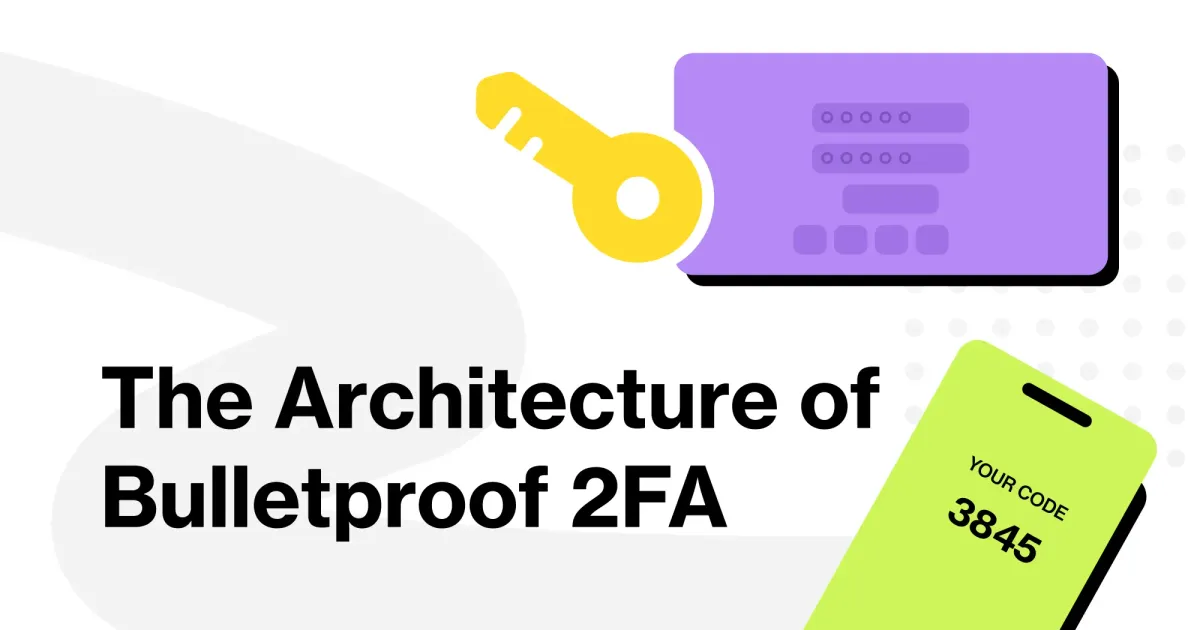
The Architecture of Bulletproof 2FA: Securing High-Risk Financial Transactions via Direct MNO
SMS codes alone can't stop modern account takeover. Here's how to architect layered, phishing-resistant 2FA with TOTP, WebAuthn, and step-up authentication — and why NIST just changed the rules on SMS OTP.

Bulletproof 2FA isn't one factor it's a layered architecture. It pairs a phishing-resistant primary method (WebAuthn/passkeys, or TOTP as a step down) with risk-based step-up challenges, rate limiting, device and behavioral signals, and a recovery path that doesn't quietly reopen the door the second factor was supposed to close. NIST's latest Digital Identity Guidelines now formally classify SMS and PSTN-based one-time passcodes as a "restricted authenticator" the first time NIST has created that category, which means SMS OTP is still allowed, but only with compensating controls layered on top. TypingDNA
Key Takeaways
- NIST SP 800-63B Revision 4 places SMS/PSTN OTP into a new "restricted authenticator" category it's permitted, not preferred. TypingDNA
- Javelin Strategy & Research's 2025 Identity Fraud Study put total U.S. identity fraud losses at $27.2 billion in 2024, up 19% year over year, with account takeover fraud accounting for $16 billion of that. Stingrai
- Adversary-in-the-middle (AiTM) phishing attacks surged 146% in the past year, with roughly 40,000 incidents detected daily these target the 2FA step directly, not just the password. Obsidian Security
- NIST reserves its highest assurance level, AAL3, for authenticators that prove possession of a cryptographic key a bar SMS, voice, and basic TOTP don't clear. SailPoint
- Passkeys have crossed into the mainstream — 5 billion are now in active use worldwide yet 57% of organizations still rely on phishable methods for primary sign-in. MojoAuth
Table of Contents
- What "Bulletproof" Actually Means in 2FA Architecture
- The Authenticator Hierarchy: Know, Have, Are
- Comparing 2FA Methods: Security, UX, and Cost
- Why SMS OTP Alone Isn't Enough Anymore
- Anatomy of a Phishing-Resistant Architecture
- A Reference Implementation
- Best Practices for Designing 2FA That Holds Up
- Common Mistakes That Undermine "Bulletproof" 2FA
- A Migration Framework: From SMS-Only to Layered MFA
- FAQ
- Conclusion
Most teams treat 2FA as a checkbox: pick a method, wire up an SDK, ship it. That's how you end up with "MFA-protected" systems that still get breached, because the architecture not the individual factor is where the security actually lives. This guide breaks down how to design a 2FA system that holds up against the attacks actually being used against it today: SIM swapping, AiTM phishing proxies, and MFA fatigue.
1. What "Bulletproof" Actually Means in 2FA Architecture
No authentication method is unbreakable "bulletproof" is a claim about the system, not the code. A well-architected 2FA system has three properties:
- Phishing resistance at the primary layer. The credential exchange can't be relayed or replayed by a proxy sitting between the user and your login page.
- Defense in depth around the primary factor. Rate limiting, device fingerprinting, and anomaly detection catch what the primary factor alone can't.
- A recovery path that's as hard to attack as the front door. Most account takeovers succeed by going after account recovery and support channels rather than breaking cryptography directly. Stingrai
Get the architecture right, and any single factor's failure becomes a contained incident. Get it wrong, and even a strong factor like a hardware key can be undermined by a weak recovery flow.
2. The Authenticator Hierarchy: Know, Have, Are
Every authentication factor falls into one of three categories, and 2FA architecture is really about combining two different categories well:
- Something you know passwords, PINs, security questions
- Something you have a phone receiving an SMS, an authenticator app, a hardware security key, a passkey-bound device
- Something you are fingerprint, face, voice biometrics
NIST's Authenticator Assurance Levels (AAL1–AAL3) rank the strength of these combinations, with AAL3 the highest level requiring proof of possession of a cryptographic key through a protocol resistant to impersonation. This is the framework almost every serious 2FA architecture decision maps back to, whether or not you're a government contractor bound by it directly. SailPoint
3. Comparing 2FA Methods: Security, UX, and Cost
| Method | How It Works | Phishing Resistance | NIST AAL | User Friction | Cost Profile |
|---|---|---|---|---|---|
| SMS OTP | Code sent via text | Low — restricted authenticator TypingDNA | AAL1 (restricted) | Very low | Carrier fees, 10DLC registration, delivery variability |
| Voice OTP | Code read via automated call | Low — same PSTN exposure | AAL1 (restricted) | Low, slower | Higher per-unit cost, useful as fallback |
| TOTP (authenticator app) | Time-based code, RFC 6238 | Medium — immune to push fatigue but interceptable by real-time AiTM proxies Authn8 | AAL2 | Medium (manual entry) | Near-zero delivery cost |
| Push notification | Approve/deny prompt | Medium–High with number matching | AAL2 | Very low | App infrastructure cost |
| WebAuthn / FIDO2 security key | Public-key cryptography, hardware-bound | High — verifier-impersonation-resistant | AAL3 | Low after enrollment | Hardware cost per user |
| Passkeys (synced WebAuthn) | Public-key cryptography, platform-bound | High | AAL2–AAL3 | Very low — ~93% login success rate vs. ~63% for passwords MojoAuth | No hardware needed |
| Backup/recovery codes | Pre-generated one-time codes | N/A — fallback only | N/A | Rare use | Storage/delivery cost |
The takeaway isn't "SMS is bad, delete it." It's that SMS and voice OTP belong in your architecture as a fallback or step-up channel, not as your only or primary factor for anything protecting sensitive access.
4. Why SMS OTP Alone Isn't Enough Anymore
Three separate trends converged to push SMS OTP out of the "primary factor" role:
SIM swapping industrialized. A 2020 Princeton CITP study found 39 of 50 attempted SIM swaps succeeded across five major U.S. prepaid carriers, and 17 of over 140 surveyed websites were vulnerable to account takeover from a SIM swap alone no password needed. That vulnerability hasn't closed; it's scaled. CrowdStrike recorded a 442% surge in vishing attacks between the first and second half of 2024, largely attributed to help-desk impersonation tradecraft used by groups like Scattered Spider, and that group's SIM-swap-enabled social engineering was behind the MGM Resorts breach in September 2023, with roughly $100 million in financial impact. Stingrai + 2
AiTM phishing kits now target the OTP step directly. Eleven major adversary-in-the-middle phishing kits now circulate commercially, letting attackers intercept authentication tokens in real time as a user completes what looks like a normal login. The user isn't tricked into revealing a secret they're tricked into authenticating to the attacker's proxy instead of your real login page, and the OTP gets relayed through in real time. Obsidian Security
NIST changed the rules. SP 800-63B Revision 4 introduced "restricted authenticator" as an entirely new classification, and put SMS/PSTN OTP into it, with the explicit note that NIST may tighten that status further as the threat landscape evolves. That's a regulatory and industry-standard signal, not just a security blog opinion. TypingDNA
None of this means SMS OTP delivery infrastructure stops mattering it's still one of the highest-reach channels for reaching users, and it's often the right fallback for account recovery or low-risk actions. It means it shouldn't be the only wall between an attacker and a high-value account.
5. Anatomy of a Phishing-Resistant Architecture
A production-grade 2FA architecture is really five components working together:
- Primary authenticator — WebAuthn/passkey where possible, TOTP as the next-best option.
- Step-up logic — a risk engine that requires a stronger factor for sensitive actions (new device, new location, high-value transaction) even if the user is already "authenticated."
- Rate limiting and code lifecycle rules — codes expire fast, are single-use, and lockouts trigger well before brute-force becomes viable.
- Fraud and delivery signals detecting SIM-swap-adjacent signals (recent number porting, carrier change) and OTP/SMS pumping patterns before a code is even sent.
- Recovery flow parity — account recovery must meet the same assurance bar as normal login, or it becomes the actual front door.
┌─────────────┐      ┌──────────────────┐      ┌────────────────┐
│   Login      │─────▶│  Risk Engine      │─────▶│  Factor Router  │
│  (password/  │      │  (device, geo,    │      │  Low risk → TOTP │
│   passkey)   │      │   velocity, SIM    │      │  High risk → step-up
└─────────────┘      │   porting signal) │      │  WebAuthn required│
                      └──────────────────┘      └────────────────┘
6. A Reference Implementation
TOTP verification itself is a solved problem any standards-compliant library (RFC 6238) handles the code generation and time-window matching. What matters architecturally is the step-up logic layered on top: deciding when to demand a stronger factor based on device recognition, recent SIM porting signals, or the risk level of the action being taken, not just verifying a code in isolation.
7. Best Practices for Designing 2FA That Holds Up
- Default to phishing-resistant factors for high-value accounts. WebAuthn/passkeys wherever the platform supports it.
- Use number matching on push notifications, not simple approve/deny this is the direct fix for MFA fatigue attacks.
- Treat SMS/voice OTP as a fallback and recovery channel, not the only factor guarding sensitive actions.
- Rate-limit at the code level and the account level cap attempts per code and per account per hour.
- Detect SIM-swap-adjacent signals (recent porting, carrier changes) before trusting a phone number for a step-up challenge.
- Apply the same assurance level to account recovery as to login. A weak "forgot password" flow undoes a strong login flow.
- Log and alert on OTP request volume anomalies — a spike often precedes fraud, not follows it.
- Give users a phishing-resistant option even if you can't force it offering passkeys alongside SMS meaningfully reduces exposure without breaking accessibility.
8. Common Mistakes That Undermine "Bulletproof" 2FA
- Treating 2FA as binary (on/off) instead of risk-tiered. The same factor requirement for a login and a wire transfer is a design gap, not a security posture.
- Allowing unlimited OTP resend requests, which both enables brute force and opens the door to SMS pumping fraud.
- Push notifications without number matching, which is precisely what enabled the 2022 push-bombing attack against Uber, where an exhausted employee approved a prompt just to stop the notifications. Obsidian Security
- Recovery flows that only require the phone number, effectively making the "second" factor the only factor.
- No migration path off SMS-only despite passkey adoption reaching mainstream levels, more than half of organizations still default to phishable primary authentication simply because no one prioritized the migration. MojoAuth
- Assuming TOTP is phishing-proof. TOTP resists fatigue and bombing attacks because there's no push to spam, but a real-time AiTM proxy can still capture and relay a TOTP code as the user types it. Authn8
9. A Migration Framework: From SMS-Only to Layered MFA
| Stage | Primary Factor | Fallback | Step-Up For |
|---|---|---|---|
| 1 — Baseline | SMS OTP | Voice OTP | N/A (starting point) |
| 2 — Hardened | TOTP (authenticator app) | SMS OTP | New device login |
| 3 — Risk-tiered | TOTP + risk engine | SMS OTP | High-value actions, new device, geo anomaly |
| 4 — Phishing-resistant | WebAuthn / passkeys | TOTP → SMS (last resort) | Any elevated-risk action |
Most enterprise teams don't jump from Stage 1 to Stage 4 — passkey rollout benchmarks vary sharply by industry, from roughly 60% adoption in fintech to under 20% in media and entertainment, largely reflecting how much friction each business is willing to accept during rollout. The realistic path is incremental: add TOTP or passkeys as an option first, make it the default for new accounts second, and reserve SMS for fallback and recovery last. MojoAuth
FAQ
What is 2FA architecture?
2FA architecture is the overall system design behind two-factor authentication which factors are offered, how risk determines which factor is required, how rate limiting and fraud detection are layered in, and how account recovery is secured. It's distinct from simply choosing a single 2FA method.
Is SMS OTP still safe to use for 2FA?
It's still widely used and better than no second factor at all, but NIST now classifies it as a "restricted authenticator," meaning it's permitted only with additional compensating controls rather than recommended as a primary method for high-assurance use cases. TypingDNA
What's the difference between TOTP and push notifications?
TOTP generates a time-based code the user manually enters; push notifications send an approve/deny prompt to a registered device. TOTP can't be "fatigued" through repeated prompts, but both can be defeated by real-time phishing proxies if number matching and rate limiting aren't in place.
Are passkeys the same as 2FA?
Not exactly. A passkey can function as a single, phishing-resistant factor that replaces both password and OTP, or as one factor in a broader MFA policy. Functionally, it delivers the assurance of a strong two-factor setup in a single step.
What is a phishing-resistant authenticator?
An authenticator where the cryptographic proof is bound to the specific site being logged into, so a phishing proxy can't relay it to a fake login page. WebAuthn/FIDO2 (including passkeys) are the primary examples; SMS, voice, and basic TOTP codes are not phishing-resistant because the secret itself can be relayed.
What is NIST's Authenticator Assurance Level (AAL)?
AAL is NIST's three-tier ranking (AAL1–AAL3) of authentication strength, with AAL3 requiring proof of possession of a cryptographic key through a protocol resistant to impersonation — the bar only hardware-bound or platform-bound WebAuthn methods clear. SailPoint
How do I migrate users from SMS OTP to stronger authentication?
Offer the stronger option (TOTP or passkeys) alongside SMS rather than forcing a switch, make it the default for new signups, monitor adoption, and only after adoption climbs should SMS be moved to a fallback/recovery-only role.
What is an MFA fatigue attack and how do you prevent it?
An attacker who already has valid credentials repeatedly triggers push notifications, hoping the user approves one out of frustration. This tactic was behind the 2022 Uber breach. Number matching, rate-limited prompts, and switching high-risk accounts to phishing-resistant factors are the direct fixes. Obsidian Security
Conclusion
"Bulletproof" 2FA was never about finding one unbreakable factor — it's about designing a system where no single factor's weakness becomes the whole system's weakness. SMS OTP still has a legitimate role as a delivery-reliable fallback channel; it just shouldn't be doing the job of a primary, phishing-resistant authenticator anymore, and the standards bodies now agree.
If you're auditing your current authentication stack, the fastest way to find the gap is to ask one question: what does account recovery require? That's usually where the real assurance level of a system lives, no matter what the login page shows.
Not sure whether your current 2FA setup would hold up against a SIM swap or an AiTM phishing kit?
Yootelco Verify combines OTP delivery, fraud signal detection, and step-up logic in a single API built for teams who need reliable delivery and a migration path to phishing-resistant authentication. Talk to a Yootelco specialist →