Hidden Costs of Enterprise CPaaS: A2P SMS Volume vs. Routing Control

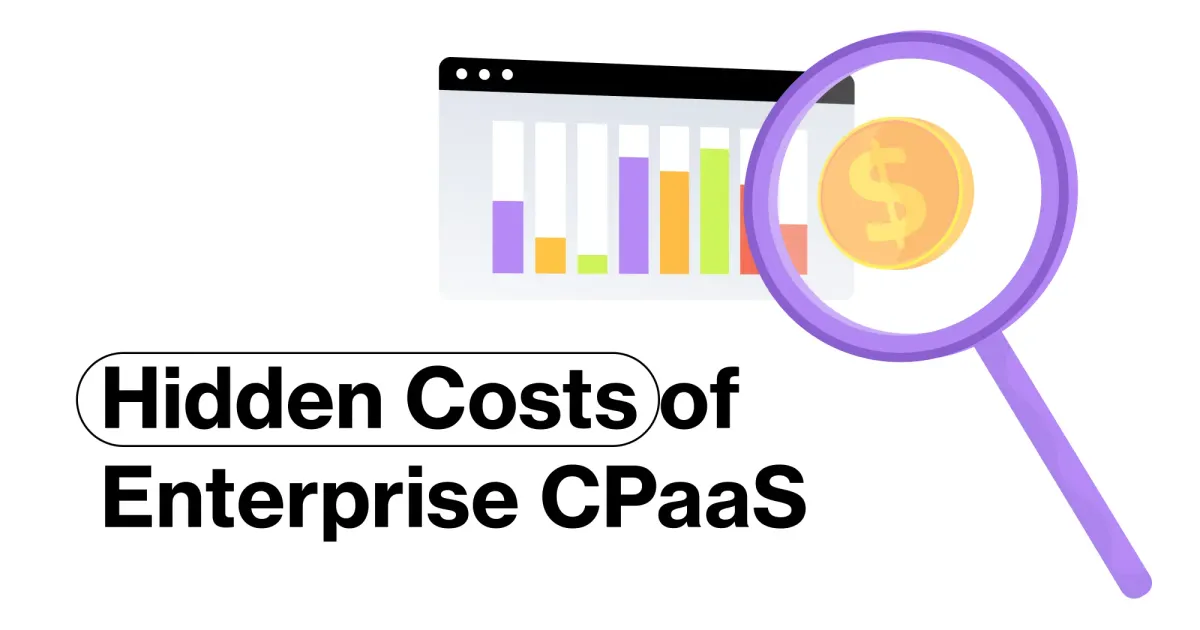
Enterprise CPaaS pricing rarely matches the final invoice. Beyond the advertised per-message and per-minute rates, most contracts carry carrier pass-through surcharges, A2P 10DLC registration and campaign fees, number and E911 charges, overage penalties, fraud exposure from artificially inflated traffic, TCPA compliance risk, and paid support tiers. Calculating true total cost of ownership not the rate card is the only way to compare providers accurately.
Key Takeaways
- Advertised per-message and per-minute rates typically represent only part of the real monthly bill once carrier surcharges, registration fees, and compliance costs are layered on.
- A2P 10DLC alone can add brand and campaign registration fees, recurring monthly campaign charges, and per-segment carrier surcharges from AT&T, T-Mobile, and Verizon.
- Artificially inflated traffic (AIT), also called SMS pumping, is estimated to cost businesses more than $1 billion globally each year and the bill lands on the company sending the messages, not the carrier.
- TCPA violations carry $500–$1,500 in statutory damages per message with no cap on aggregate liability, turning a small compliance gap into a balance-sheet event.
- The only reliable way to compare CPaaS providers is a total cost of ownership (TCO) model that adds registration, overage, fraud, compliance, and support costs to the base rate card not the rate card alone.
Table of Contents
- What "Hidden Costs" Actually Means in a CPaaS Contract
- The 10 Hidden Cost Categories in Enterprise CPaaS Pricing
- Advertised Price vs. Real Cost: A Side-by-Side Comparison
- A Real-World Example: What a "Simple" SMS Program Actually Costs
- How to Calculate the True Total Cost of Ownership for CPaaS
- Best Practices for Avoiding Hidden CPaaS Costs
- Common Mistakes Enterprises Make When Evaluating CPaaS Pricing
- FAQ
- Conclusion
Introduction
Every CPaaS deal starts the same way. Procurement gets a rate card $0.0079 per SMS segment, $0.013 per voice minute, maybe a volume discount at 500,000 messages a month. It looks clean. It looks comparable. Someone builds a spreadsheet, picks the lowest number, and signs.
Then the first real invoice arrives, and it doesn't match the spreadsheet.
That gap isn't usually fraud or bad faith on the vendor's part; most of it is disclosed somewhere in the terms, just not on the page anyone read closely. Carrier surcharges, registration fees, compliance charges, and support tiers are standard, industry-wide line items. Every CPaaS provider, from the largest platforms to regional resellers, passes through some version of them. The problem for enterprise buyers isn't that these costs exist. It's that they're rarely part of the number used to make the buying decision.
This guide breaks down the ten cost categories that most commonly go unmentioned during CPaaS evaluation, walks through what they look like on an actual invoice, and gives you a framework for calculating total cost of ownership before you sign not after your finance team asks why the messaging line item tripled.
What "Hidden Costs" Actually Means in a CPaaS Contract
In enterprise CPaaS, a "hidden cost" is any charge that sits outside the quoted per-unit rate but is still billed to the customer carrier surcharges, registration fees, overage penalties, fraud exposure, and compliance risk. These costs are usually disclosed in the contract's fine print or a separate fee schedule, but rarely included in the headline price used during vendor comparison.
None of this makes CPaaS pricing dishonest. It makes it unbundled and unbundled pricing only becomes a problem when the buyer evaluates offers using the bundled number from one vendor against the unbundled number from another.
The 10 Hidden Cost Categories in Enterprise CPaaS Pricing
1. Carrier Pass-Through Fees and Surcharges
Base messaging and voice rates cover the CPaaS platform's own margin. They don't cover what mobile network operators (MNOs) charge to terminate traffic on their networks. Surcharges are typically billed separately from the per-message or per-minute rate and can materially change the effective cost per unit at scale, especially once volume moves across multiple carriers and countries. Because these fees are set by carriers, not the CPaaS vendor, they change independent of your contract's negotiated rate and they show up as separate line items your rate card never mentioned.
2. A2P 10DLC Brand and Campaign Registration
If you send application-to-person SMS to U.S. mobile numbers from a standard 10-digit number, you're required to register through The Campaign Registry (TCR). This isn't optional or provider-specific since February 2025, major U.S. carriers block unregistered A2P traffic outright. The fee structure typically includes:
- A one-time brand registration fee (commonly $4–$50+, depending on entity type and whether secondary vetting is required)
- A one-time campaign vetting fee (roughly $15–$17 per campaign, charged again on rejected resubmissions)
- Recurring monthly campaign fees (roughly $1.50–$10 per campaign, billed monthly)
- Per-segment carrier surcharges from AT&T, T-Mobile, and Verizon (roughly $0.003–$0.005 per registered SMS segment, with unregistered traffic charged at a materially higher rate)
None of this is markup reputable providers pass these fees through at cost. But if a vendor's advertised rate card doesn't flag them, they land as a surprise on invoice one.
3. Number Acquisition, Porting, CNAM, and E911 Fees
Every DID (direct inward dial number) you provision or port in carries its own cost structure: monthly number leasing fees, one-time porting charges when moving numbers from another provider, CNAM lookup fees for caller ID name display, and E911 service fees for emergency-location compliance on voice numbers. Porting friction in particular is worth flagging during evaluation it's the fee category most likely to resurface later, when you try to leave a provider rather than join one.
4. Overage Charges and Rate-Limit Throttling
Most CPaaS contracts include a committed volume tier with an overage rate above it — and separately, a concurrent call or messages-per-second cap that isn't always disclosed until you hit it. Traffic spikes during a product launch, a security incident requiring mass OTP delivery, or a seasonal promotion can silently push you into overage pricing, or worse, into throttling that degrades delivery during the exact moment reliability matters most.
5. Artificially Inflated Traffic (AIT) and SMS Pumping Fraud
This is the largest and least understood hidden cost in enterprise messaging. AIT — also called SMS pumping, SMS toll fraud, or international revenue share fraud (IRSF) — works like this: a fraudster finds an unprotected OTP, login, or verification flow, uses bots to trigger thousands of fake requests, and routes the resulting messages to premium-rate or revenue-share numbers they control. The carrier or an intermediary along the route collects a cut of the messaging fee. Your business pays for every message, none of which ever reached a real customer.
One-time passwords now make up close to 90% of international A2P SMS traffic, which is exactly why OTP flows are the primary AIT attack surface. Industry estimates put global AIT losses above $1 billion annually, with 15–20% of unprotected OTP traffic on some platforms found to be fraudulent. The publicly cited example that put this on the industry's radar: X (formerly Twitter) estimated in late 2022 that it was losing roughly $60 million a year to this exact scheme across hundreds of international carriers. GSMA and national cybersecurity bodies including the UK's NCSC have since issued formal guidance urging providers and enterprises to monitor for it directly.
The uncomfortable part: this fee never shows up as a "fraud" line item. It shows up as a spike in your normal per-message billing, which is exactly why so few finance teams catch it until the pattern has run for months.
6. TCPA and Regulatory Compliance Exposure
This isn't a cost your CPaaS provider bills you — it's a cost your CPaaS provider's lack of guardrails can expose you to. The Telephone Consumer Protection Act (TCPA) sets statutory damages of $500 per negligent violation and $1,500 per willful violation, calculated per message, with no cap on total liability. A single campaign sent to 10,000 non-consenting contacts creates theoretical exposure in the $5–15 million range. TCPA class action filings rose sharply through 2025, and reported industry-wide settlements for the year topped $150 million. The FCC has separately estimated that unwanted and illegal texts cost the U.S. economy in the range of $16.5 billion annually in nuisance and enforcement costs combined. A CPaaS platform without built-in consent management, quiet-hours enforcement, and opt-out automation doesn't just create operational risk — it creates a specific, quantifiable, and uncapped legal cost that never appears on a rate card.
7. Support Tiers and SLA Add-Ons
"24/7 support" and "enterprise SLA" are frequently gated behind a higher pricing tier or a separate line item entirely. Standard support may mean email tickets with a 24–48 hour response window; the phone-based, dedicated-account-manager tier enterprises actually need for production traffic is often an upsell. Worth checking specifically: does the SLA include financial credits for downtime, and are those credits capped at a level that's meaningful relative to your actual traffic volume, or are they symbolic?
8. Professional Services and Integration Costs
Migrating a contact center, provisioning number pools across regions, or building custom webhook logic for delivery receipts and fallback routing is rarely covered by the base subscription. Enterprise CPaaS deployments commonly carry one-time implementation fees, data migration costs, and custom integration charges that scale with the complexity of your existing stack — costs that are easy to underestimate during a sales cycle focused on the per-unit rate.
9. International Routing and Multi-Channel Markups
A rate card quoted for U.S. domestic SMS or voice tells you very little about what happens when traffic crosses borders. International termination rates vary enormously by country and route quality, and providers routing through lower-cost, lower-reliability paths can produce both a higher effective cost per delivered message (once failed and retried sends are counted) and worse deliverability. The same applies to newer channels WhatsApp Business, RCS, and other OTT messaging APIs typically carry conversation-based or template-based pricing that doesn't map cleanly onto SMS-style per-segment costs, making channel-to-channel comparisons easy to get wrong.
10. Vendor Lock-In and Migration Costs
The cost of leaving is a cost of joining. Proprietary number formats, non-portable short codes, custom API implementations, and multi-year minimum commitments all raise the switching cost after year one. This doesn't show up during evaluation because it isn't billed at signing it's the cost of not being able to negotiate or leave later, which is precisely why it's worth pricing in before you commit.
Advertised Price vs. Real Cost: A Side-by-Side Comparison
| Cost Category | What the Rate Card Shows | What Actually Gets Billed |
|---|---|---|
| SMS messaging | $0.0079 per segment | + carrier surcharge (~$0.003–$0.005/segment) + 10DLC campaign fee |
| Voice | $0.013 per minute | + E911 fee + CNAM lookup + concurrent-call overage |
| Number provisioning | "$1/month per number" | + porting fee + setup fee + inbound carrier fees (T-Mobile) |
| Support | "24/7 support included" | Priority/phone support often gated to a higher tier |
| Compliance | Not listed | TCPA exposure, 10DLC brand/campaign registration, ongoing vetting |
| Fraud protection | Not listed | AIT/SMS pumping losses absorbed as normal traffic unless actively monitored |
| Scaling | "Unlimited throughput" | Soft caps and concurrent-message/call limits not disclosed until hit |
| Switching providers | Not priced | Porting delays, custom integration rework, contract minimums |
A Real-World Example: What a "Simple" SMS Program Actually Costs
Consider a mid-size fintech sending 200,000 SMS messages a month to U.S. numbers — mostly OTPs for login, plus a smaller volume of account alerts.
| Line Item | Estimated Monthly Cost |
|---|---|
| Base SMS rate (200,000 segments @ $0.0079) | $1,580 |
| Carrier 10DLC surcharge (200,000 @ ~$0.004 avg.) | $800 |
| Monthly campaign fee (2 campaigns @ ~$10) | $20 |
| Number leasing (10 local numbers @ ~$1) | $10 |
| Support tier upgrade (phone support add-on) | $150–$400 |
| Subtotal before risk factors | ~$2,560–$2,810 |
Now add what most rate-card comparisons leave out entirely: if just 10% of that OTP volume were AIT fraud — a conservative figure against industry estimates of 15–20% on unprotected flows — that's roughly 20,000 fraudulent messages costing an additional $160–$180 a month in base rate alone, invisible inside normal traffic. And if that fintech's marketing team sent even one unregistered promotional blast to 10,000 contacts without documented consent, the theoretical TCPA exposure alone — $500–$1,500 per message — dwarfs the entire annual messaging budget.
The rate card said $0.0079 per message. The real number was never a single per-message rate at all.
How to Calculate the True Total Cost of Ownership for CPaaS
Use this formula as a working model when comparing vendors or auditing a renewal:
True Monthly Cost = Base Usage Rate + Carrier Surcharges + Registration & Compliance Fees + Number/DID Fees + Support Tier + Estimated Fraud Exposure + Amortized Implementation Cost
A practical checklist to build it out:
- Get the full fee schedule, not just the rate card. Ask explicitly for every pass-through fee (carrier, 10DLC, E911, CNAM) itemized separately from platform margin.
- Model your actual traffic mix, not a flat average — SMS, voice, WhatsApp, and international traffic all carry different fee structures.
- Ask what's included in "support" and get the SLA credit terms in writing, including the cap.
- Ask what fraud monitoring is built in versus sold as an add-on, and what your liability is for AIT traffic under the contract.
- Price your compliance stack — consent capture, opt-out automation, quiet-hours enforcement — as part of the platform, not a separate legal-team project.
- Model a 3x traffic spike scenario to see where overage or throttling kicks in.
- Price the exit, not just the entry — porting timelines, minimum terms, and data portability.
Best Practices for Avoiding Hidden CPaaS Costs
- Request an itemized invoice sample before signing, not just a rate card.
- Register 10DLC brands and campaigns early — delays translate directly into blocked traffic and lost revenue, not just inconvenience.
- Put rate-limit throttling thresholds and overage pricing in writing, tied to your actual peak volume, not your average.
- Require fraud/AIT detection as a contractual feature, not a "nice to have," especially on any OTP or verification flow.
- Build TCPA consent capture and opt-out handling into your integration from day one — retrofitting it after a lawsuit is the expensive path.
- Negotiate SLA credits as a percentage of your actual monthly spend, not a flat, symbolic figure.
- Re-run your TCO model annually. Carrier surcharges and compliance fees change independent of your contract terms.
Common Mistakes Enterprises Make When Evaluating CPaaS Pricing
- Comparing rate cards instead of total cost of ownership across vendors that bundle differently.
- Treating 10DLC as a one-time task instead of an ongoing registration and monthly fee obligation.
- Assuming "unlimited" means uncapped — most platforms have soft throughput limits that only surface under load.
- Skipping fraud monitoring on OTP flows because volume looks "organic" until the invoice proves otherwise.
- Leaving TCPA compliance to the marketing team instead of building it into the platform and the API integration itself.
- Not asking what happens at renewal — introductory pricing and volume discounts are frequently time-limited.
- Underestimating porting and migration costs when evaluating a switch, which quietly locks in an underperforming vendor.
FAQ
What are the most common hidden costs in CPaaS pricing? The most common are carrier pass-through surcharges, A2P 10DLC registration and monthly campaign fees, number and E911 charges, overage penalties above committed volume, and support-tier upgrades — none of which are typically shown in the headline per-message or per-minute rate.
What is A2P 10DLC and why does it cost extra? A2P 10DLC (Application-to-Person 10-Digit Long Code) is the carrier-mandated registration system U.S. mobile networks require for business text messaging sent from standard local numbers. It carries brand registration fees, campaign vetting fees, recurring monthly campaign charges, and per-segment carrier surcharges — all separate from a CPaaS platform's base messaging rate.
How much can SMS pumping fraud actually cost a business? Industry estimates put global losses from artificially inflated traffic (AIT/SMS pumping) above $1 billion annually, with some unprotected platforms seeing 15–20% of OTP traffic being fraudulent. Because it's billed as ordinary message volume, it's rarely caught without active fraud monitoring.
Is TCPA compliance a CPaaS provider's responsibility or mine? Both. Statutory liability under the TCPA falls on the business sending the message, but a CPaaS platform's built-in consent management, opt-out automation, and quiet-hours enforcement materially reduce the risk of a violation. When comparing providers, ask specifically what compliance tooling is included versus what you'd need to build yourself.
What's a realistic total cost of ownership model for CPaaS? A working model adds base usage rate + carrier surcharges + registration/compliance fees + number/DID fees + support tier + estimated fraud exposure + amortized implementation cost. Comparing vendors on base rate alone consistently understates the real difference between offers.
Do all CPaaS providers charge the same carrier surcharges? Carrier surcharges are set by the mobile network operators (AT&T, T-Mobile, Verizon, and international carriers), not by individual CPaaS providers, so the underlying fees are largely consistent across vendors. What differs is transparency — whether a provider itemizes these pass-through costs clearly or folds them into a less transparent all-in rate.
How can I estimate hidden costs before signing a CPaaS contract? Ask for an itemized sample invoice, not just a rate card; get the full fee schedule for carrier surcharges, 10DLC, and number charges in writing; and model your actual traffic mix and peak volume rather than a flat monthly average.
What should an enterprise CPaaS RFP specifically ask for? A complete fee schedule (not just per-unit rates), documented overage and throttling thresholds, included fraud/AIT monitoring, TCPA-relevant compliance tooling, SLA credit terms with caps, and a clear number-porting and data-portability policy for the exit scenario.
Conclusion
None of the ten cost categories in this guide are unusual, and none of them make a CPaaS provider dishonest. Carrier surcharges, 10DLC fees, and compliance exposure are structural realities of how SMS and voice traffic actually move through the telecom ecosystem — every enterprise buyer runs into some version of them eventually. The difference between a good CPaaS decision and an expensive one isn't avoiding these costs. It's pricing them in before you sign, not after the invoice does the math for you.
If you're comparing providers or auditing a renewal, the fastest way to get clarity is to build the total cost of ownership model above using your own traffic — not the vendor's example numbers.
Not sure what your current CPaaS contract is really costing you? Yootelco's team will review your last few invoices with you, line by line, and show you exactly which charges are standard carrier pass-through, which are markup, and where you actually have room to negotiate, no obligation.