CPaaS vs. Telecom-Native Infrastructure: Which One Actually Delivers?

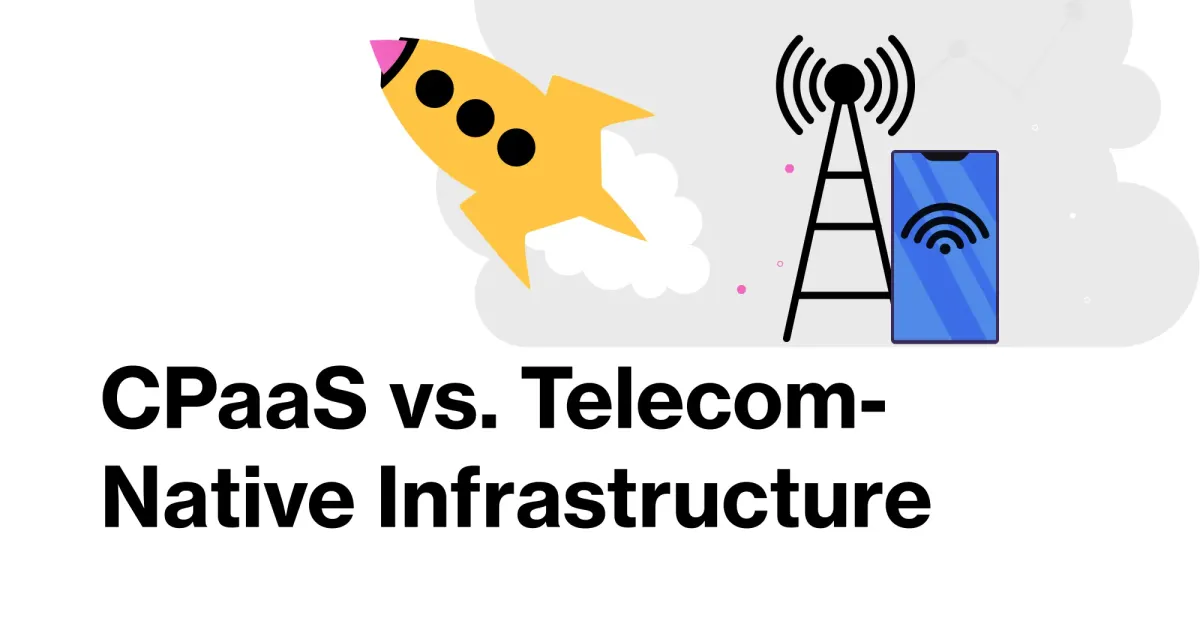
CPaaS (Communications Platform as a Service) is a third-party layer that lets you add messaging, voice, and video to your app through an API, while telecom-native infrastructure means connecting directly to carrier networks without a reseller in between. The practical difference shows up the moment your OTP codes, payment alerts, or customer calls hit real-world network conditions: one model routes your traffic through someone else's aggregation layer, the other puts you on the network itself.
For MNOs, fintechs, banks, and enterprises where a delayed OTP or a dropped call is a lost transaction, not just an inconvenience, that difference is the whole decision.
What Is CPaaS?
CPaaS is a cloud platform that gives developers pre-built APIs for SMS, voice, video, and chat, so they don't have to build telecom infrastructure themselves. Providers like Twilio, Vonage, and Sinch abstract away the underlying carrier relationships and sell you a simplified, developer-friendly interface instead.
That abstraction is CPaaS's biggest selling point and its biggest limitation. You get to market fast, but you also inherit whatever routing decisions the platform makes on your behalf, often invisibly.
What Is Telecom-Native Infrastructure?
Telecom-native infrastructure means your provider operates or holds direct interconnect agreements with mobile network operators, rather than reselling capacity purchased from someone else. Practically, this looks like direct A2P SMS routes, owned SIP trunking for voice, and OTP delivery paths that don't pass through multiple resale layers before reaching the handset.
The tradeoff is less abstraction and, often, more setup conversation upfront — but far more visibility and control once you're live.
CPaaS vs. Telecom-Native Infrastructure at a Glance
| CPaaS (Reseller Layer) | Telecom-Native Infrastructure | |
|---|---|---|
| Routing control | Often abstracted; may use least-cost routing across multiple sub-vendors | Direct, often visible per-carrier routing |
| OTP/SMS reliability | Varies by hidden downstream route quality | Built around direct, operator-approved routes |
| Pricing model | Simple per-message API pricing, margin stacked on top of underlying cost | Closer to wholesale/carrier pricing |
| Latency for time-sensitive traffic | Can vary if traffic is rerouted through congested or grey paths | Predictable, since the path is known and managed |
| Compliance visibility | Depends on what the platform discloses | Direct line of sight into interconnect agreements |
| Best for | Startups needing to launch fast with minimal telecom knowledge | Regulated, high-volume, or reliability-critical businesses (fintech, banking, MNOs) |
| Setup speed | Fast — sign up and get an API key same day | Slower — typically involves onboarding and route provisioning |
Why the Routing Layer Is the Real Story
The comparison above looks like a feature checklist, but the actual risk with CPaaS isn't the API — it's what happens after the API call, on the network layer you don't see.
Multi-layer CPaaS resale arrangements can quietly route SMS traffic through grey routes: paths that disguise business (A2P) traffic as ordinary person-to-person messages to dodge operator termination fees. A grey route might hit 92% delivery today and drop to 40% tomorrow the moment a carrier's firewall catches up to it, since these routes are structurally unstable and actively hunted by carrier detection systems.
That instability lands hardest on time-sensitive traffic. Independent estimates suggest 10 to 15% of SMS OTPs never reach their intended recipient at all, and the failure is often invisible to the sender most SMS gateways mark a message "delivered" the instant a carrier accepts it, regardless of what happens between acceptance and the handset. For unregistered or improperly routed A2P traffic, delivery failure rates of 20 to 60% are common numbers no fintech or bank can absorb on a login or payment confirmation flow.
We've broken down exactly how this plays out for authentication traffic in our guide to why SMS messages fail to deliver it's worth reading alongside this piece if OTP delivery is already causing support tickets.
Why This Matters More Right Now
CPaaS adoption is accelerating fast the global market was valued at roughly $23–31 billion in 2025–2026 and is projected to keep growing at a 25–33% CAGR through the early 2030s, depending on the analyst firm, as more businesses embed messaging and voice into their products (Research and Markets; Fortune Business Insights). That growth is a genuine sign the underlying use case programmable, API-driven communication is here to stay.
But growth in the market doesn't mean every business should sit on top of a reseller layer indefinitely. As volume increases, so does exposure to whatever routing decisions sit underneath the API and regulated industries (banking, fintech, MNOs) are exactly the ones with the least tolerance for that exposure.
The Hidden Cost Math Most Comparisons Skip
Most CPaaS vs. telecom-native comparisons stop at the per-message price, because that's the number that's easy to put in a spreadsheet. It's also the least useful number if your traffic includes OTP, payment confirmations, or fraud alerts.
Here's the math that actually matters: a message that costs a fraction of a cent to send but fails to arrive isn't cheap it's a lost transaction. If a fintech app sends 500,000 OTPs a month and even 10% fail to land inside the validity window (a figure well within the range reported for grey-route-dependent traffic), that's 50,000 failed logins or payment confirmations. Each of those becomes a support ticket, a retry, an abandoned session, or in the worst case, a customer who doesn't come back. None of that shows up on the CPaaS invoice, because the platform already counted the message as "delivered" the moment a carrier accepted it.
Telecom-native infrastructure doesn't eliminate cost direct routes are typically priced closer to real carrier rates, which can look higher line-by-line than a heavily discounted CPaaS rate. What it does is make the tradeoff visible: you're paying for a known route with defined delivery and latency commitments, instead of an unknown one that may or may not hold up under carrier firewall updates. For high-volume, compliance-sensitive senders, that visibility is usually worth more than the per-message discount.
Where CPaaS Genuinely Makes Sense
To be fair to the model: CPaaS is often the right call, not just the fast one.
- Early-stage products validating a feature (like adding SMS notifications to an app) before committing to telecom relationships.
- Low-volume, non-critical messaging marketing blasts, reminders, or anything where a missed message isn't a compliance or revenue event.
- Teams without in-house telecom expertise who need a working integration this week, not this quarter.
The tradeoff is straightforward: you're paying a convenience premium and accepting reduced visibility in exchange for speed. That's a reasonable trade for the right use case it stops being reasonable the moment OTPs, payment confirmations, or regulatory-grade messaging are on the line.
Where Telecom-Native Infrastructure Wins
For MNOs, banks, fintechs, and enterprises operating at real volume, telecom-native infrastructure earns its slower setup:
- Authentication (OTP) traffic needs premium, direct routes with defined latency not best-effort delivery through least-cost routing. Our OTP verification infrastructure is built specifically around this: direct carrier routes, so codes arrive inside the validity window instead of after it.
- A2P SMS at scale transaction alerts, appointment reminders, fraud notifications — needs consistent, compliant delivery across markets, which is the core of our A2P SMS service.
- Voice traffic for contact centers or embedded calling features benefits from owned interconnects rather than resold capacity, which is where SIP trunking and wholesale voice come in for carriers and enterprises operating at scale.
How to Choose: A Quick Decision Framework
- Is the traffic time-sensitive or compliance-relevant? (OTP, payment confirmations, fraud alerts) → lean telecom-native.
- What's your monthly volume? Low volume, early-stage → CPaaS is fine to start. High volume → the hidden cost of a failed message (support tickets, churn, fraud exposure) compounds fast.
- Do you need to know exactly where your traffic is routed? Regulated industries (banking, fintech) generally need this visibility for audit and compliance reasons — CPaaS resale layers often can't fully provide it.
- Can you tolerate a delivery rate that quietly degrades over time? Grey-route-dependent paths can drop from 95% to 76% delivery over weeks without any alert firing on your end — direct routes don't have that failure mode.
If two or more of your answers point toward "time-sensitive," "high volume," "need visibility," or "can't tolerate degradation," telecom-native infrastructure is the safer long-term foundation.
Ready to See the Difference in Your Own Traffic?
If OTP delivery, SMS reliability, or voice quality is already costing you support tickets or conversions, the fastest way to know whether it's a routing problem is to look at your actual delivery data — not just what your current dashboard reports as "delivered."
Talk to the Yootelco team about moving your authentication, messaging, or voice traffic onto direct, telecom-native routes built for MNOs, fintechs, banks, and enterprises that can't afford a silent delivery failure.
FAQ
Is CPaaS the same as telecom-native infrastructure?
No. CPaaS is a software layer that resells or aggregates underlying telecom capacity through an API. Telecom-native infrastructure means direct interconnect agreements with carriers, without a reseller layer in between.
Is CPaaS cheaper than telecom-native infrastructure?
Often, yes, on a per-message sticker price — but CPaaS pricing includes a margin on top of whatever underlying route it uses, and that route quality isn't always disclosed. Telecom-native pricing tends to sit closer to actual carrier cost, with fewer hidden reliability tradeoffs.
Why do OTP codes sometimes arrive late or not at all?
The most common causes are grey routes, carrier filtering, network congestion, and multi-hop indirect paths that add unpredictable latency. Most SMS gateways report a message as "delivered" once a carrier accepts it, so the sender often can't see failures that happen between acceptance and the handset.
Can a business switch from CPaaS to telecom-native infrastructure without downtime?
Yes, in most cases. Migrations are typically done route-by-route or channel-by-channel (starting with the highest-risk traffic, like OTP), so messaging and voice services stay live while the underlying infrastructure changes.
Does telecom-native infrastructure work for low-volume businesses too?
It can, but the value is clearest at scale or for compliance-sensitive traffic. Low-volume, non-critical use cases (like marketing SMS) often don't need the added visibility and control, which is why CPaaS remains a reasonable choice there.
What industries benefit most from telecom-native infrastructure?
Banks, fintechs, MNOs, and any enterprise sending high volumes of authentication, transactional, or compliance-relevant messages benefit most, since these are the use cases where a failed or delayed message has real financial or regulatory consequences.
How do I know if my current provider is using grey routes?
Ask directly whether your provider has formal, operator-approved A2P interconnect agreements in the markets you send to, or whether traffic is routed through third-party aggregators using least-cost routing. Slow, inconsistent, or steadily declining delivery rates over time — without any change on your end — are a common symptom of grey-route dependency, since carriers periodically update firewall rules to detect and block these paths.
Still Deciding? Let's Look at Your Traffic Together
Whether you're already on CPaaS and suspect a routing problem, or you're building new OTP, messaging, or voice infrastructure from scratch, the fastest way to get a straight answer is to walk through your actual traffic with someone who isn't selling you an API; they're offering a network.
Get in touch with Yootelco, and we'll help you figure out, route by route, whether telecom-native infrastructure makes sense for your business.