SMS OTP vs Email OTP vs Authenticator Apps

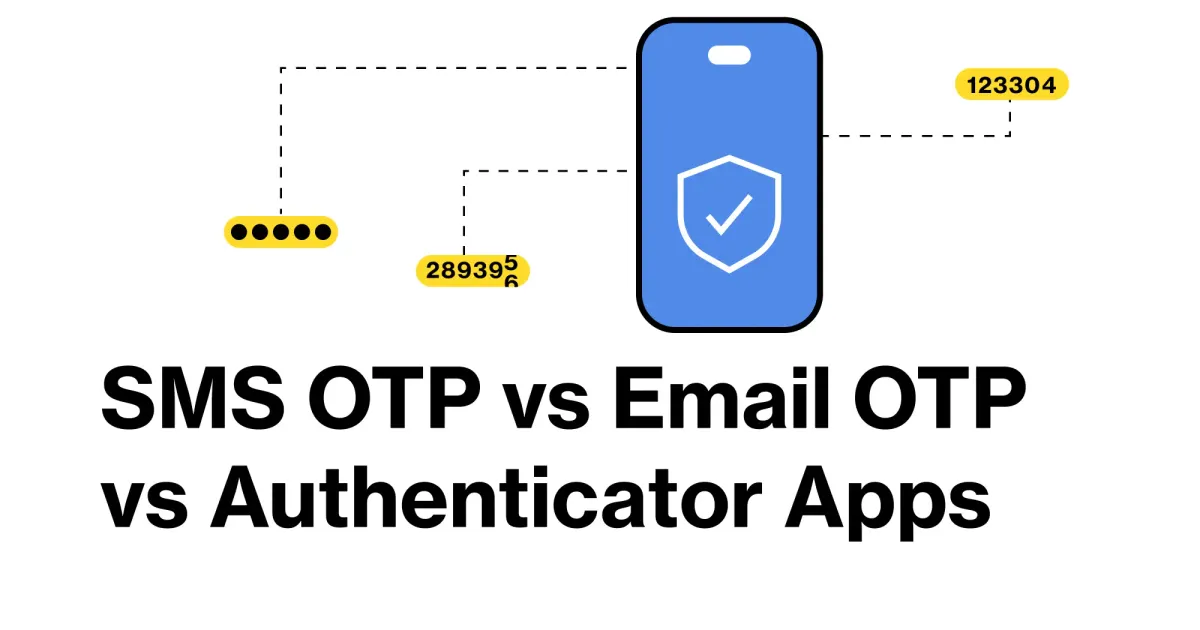
SMS OTP verifies users by sending a one-time code to their phone; email OTP sends the same code to an inbox, and authenticator apps generate time-based codes locally on a device without any network delivery at all. Each method trades off speed, cost, security, and user friction differently, and the right choice depends on what you're protecting, who your users are, and how fast they need to get in.
For CPaaS businesses, SMS platform owners, and enterprises building login or checkout flows, this isn't a theoretical debate. Picking the wrong OTP channel can mean higher cart abandonment, more support tickets, or worse, an account takeover headline. This guide breaks down all three methods, supports the comparison with current security and delivery data, and provides a practical framework for choosing (or combining) them.
Quick Comparison: SMS OTP vs Email OTP vs Authenticator Apps
| Factor | SMS OTP | Email OTP | Authenticator App (TOTP) |
|---|---|---|---|
| Delivery speed | Seconds (network-dependent) | Seconds to minutes (spam filters, throttling) | Instant, offline |
| Device required | Any mobile phone, no app needed | Any device with email access | Smartphone with authenticator app installed |
| Typical open/engagement rate | High — texts are read almost immediately | Lower — inbox competition and delays | N/A — user generates the code themselves |
| Main attack surface | SIM swap, SS7 interception, number porting | Phishing, credential stuffing, inbox compromise | Physical device theft, malware on device |
| NIST assurance status | Restricted authenticator | Limited-use, not recommended for high assurance | Accepted for AAL2 (with app-based TOTP) |
| Setup friction for users | Zero — works on any phone number | Zero — works with existing email | Requires app download and enrollment |
| Best for | Global reach, first-time users, transactional alerts | Low-risk actions, backup channel | High-value account security, security-conscious users |
| Typical cost per verification | Per-message carrier/telecom cost | Near-zero (email sending cost) | Free after setup (no delivery cost) |
What Is SMS OTP?
SMS OTP (one-time password delivered via text message) sends a short numeric code to a user's registered phone number, which they enter to confirm their identity or complete a transaction. It's the most widely deployed second factor globally because it requires no app installation and works on virtually any mobile device.
Why businesses still default to SMS OTP:
Universal reach. No app store, no internet connection at the destination device, no learning curve just a phone number.
Extremely high engagement. Text messages are read almost immediately after delivery, with open rates commonly cited in the 90–98% range, far above email's typical open rate of under 30% according to SMS marketing benchmark data.
Low abandonment during signup. Because there's nothing to install, SMS OTP keeps onboarding friction low, critical for e-commerce, fintech apps, and marketplaces competing on conversion rate.
Where SMS OTP falls short:
SIM swap and number porting fraud. Attackers convince (or bribe) carrier staff to transfer a victim's number to a new SIM, then intercept every OTP sent afterward. Fraud-monitoring firms have tracked triple-digit percentage year-over-year increases in SIM-swap incidents across multiple markets, with many attacks completing without any interaction from the victim.
SS7 network interception. The signaling protocol underlying much of the global telecom network has known weaknesses that let sophisticated attackers intercept SMS in transit.
Regulatory downgrade. In its latest Digital Identity Guidelines, NIST formally classifies PSTN-based OTPs, including SMS, as a "restricted authenticator", meaning organizations that continue to rely on it must offer an alternative, disclose the risk to users, and monitor for abnormal number-change activity.
SMS OTP remains a strong default for reach and speed, but it's no longer considered sufficient on its own for protecting high-value accounts.
What Is Email OTP?
Email OTP works the same way as SMS OTP, except the code lands in an inbox instead of a text thread. It's popular as a fallback channel or for lower-stakes verifications, password resets, newsletter confirmations, or account recovery when a phone number isn't available.
Advantages of email OTP:
No telecom cost per message and no dependency on a mobile carrier.
Works across devices: desktop, tablet, or phone without requiring a specific app.
Good secondary channel when a user's phone is unreachable, lost, or roaming internationally.
Why email OTP is the weakest of the three for security-critical flows:
Inbox compromise. If an attacker already has access to a user's email through credential stuffing, phishing, or a prior breach, an email-based OTP provides no real second factor. Verizon's 2025 Data Breach Investigations Report found that stolen credentials were involved in roughly 22% of breaches, and email remains one of the most common initial attack vectors.
Delivery delays and spam filtering. Email OTPs can land in spam folders or be delayed by throttling, hurting conversion during time-sensitive flows like checkout.
Phishing susceptibility. Because email is the primary channel attackers use to harvest credentials in the first place, sending the second factor to the same channel undermines the "something you have" principle of multi-factor authentication.
Email OTP is best treated as a convenience or backup channel, not a primary security control.
What Are Authenticator Apps?
Authenticator apps (Google Authenticator, Microsoft Authenticator, Authy, and similar tools) generate a Time-based One-Time Password (TOTP) directly on the user's device using a shared secret established at enrollment. No message is transmitted over SMS or email at all; the code is computed locally, which removes network interception as an attack vector entirely.
Why authenticator apps are the strongest of the three:
No interception surface. Since nothing travels over SMS or email, SIM swap, SS7 exploits, and inbox compromise don't apply.
Offline functionality. Codes generate without an internet or cellular connection.
Preferred by security standards. App-based TOTP is accepted at NIST's AAL2 assurance level, and phishing-resistant methods built on similar cryptographic principles (like passkeys) are increasingly the direction security frameworks are pushing toward.
The trade-offs:
Setup friction. Users must download an app, scan a QR code, and manage recovery if they lose the device a real barrier during first-time onboarding.
Not ideal for one-off or anonymous transactions. Authenticator apps assume a persistent account relationship, which doesn't fit transactional use cases like guest checkout or one-time delivery confirmations.
Device loss recovery is harder than simply re-verifying a phone number or email address.
Authenticator apps are the right call for account security on high-value, recurring-use accounts, but they're a poor fit for reaching new or infrequent users at scale.
Security Comparison: What the Data Actually Shows
The security gap between these three methods isn't theoretical it shows up in regulatory guidance and fraud data:
NIST has moved away from network-delivered OTPs. SMS/PSTN OTP is now explicitly labeled a restricted authenticator, and email OTP fares no better in NIST's assurance framework, largely because both depend on channels an attacker can compromise independently of the user's password.
SIM swap fraud is accelerating. Multiple fraud-tracking organizations have reported year-over-year increases exceeding 200% in SIM-swap and mobile-porting incidents, with the vast majority of cases requiring no action from the victim at all, according to recent SIM swap fraud data.
Credential-based attacks dominate breach data. Since stolen credentials remain a leading initial access vector in breach investigations, any OTP channel tied to a potentially compromised inbox inherits that risk.
None of this means SMS OTP or email OTP are unusable; it means they need to be deployed with an understanding of what they protect against, and layered with additional controls where the stakes are higher.
Which Verification Method Should You Choose?
There's no single "best" answer; the right choice depends on the use case:
Onboarding and first-time verification (OTP for signup, guest checkout): SMS OTP wins on reach and conversion. Most new users won't install an authenticator app just to complete a purchase.
Transactional alerts (delivery confirmations, appointment reminders, order updates): SMS OTP or RCS business messaging, the richer, verified-sender successor to SMS, both work well here, since these aren't security-critical.
Account login for returning users on low-risk platforms: SMS or email OTP is usually sufficient, especially paired with device recognition or risk-based triggers.
High-value accounts (banking, crypto, admin panels, enterprise SaaS): Authenticator apps or stronger, phishing-resistant methods like passkeys should be the default, with SMS or email OTP offered only as a fallback, never the primary factor.
Global, multi-market products: SMS OTP still has the broadest reach, since it doesn't depend on app availability or reliable email delivery in every region. A2P messaging infrastructure with strong route quality matters more here than the OTP channel itself.
The Hybrid Approach Most Mature Businesses Use
Rather than picking one method, most well-run platforms combine channels based on risk:
- SMS OTP as the default first factor: fast, universal, low-friction, ideal for reaching users with no prior app relationship.
- Authenticator apps or passkeys for elevated actions: login from a new device, high-value transfers, changing account recovery details.
- Email OTP as a backup channel used when SMS delivery fails, a number is unreachable, or a user needs account recovery.
- Risk-based triggers layered on top of location mismatches, new device fingerprints, or velocity checks that escalate to a stronger factor only when something looks unusual.
This layered model is exactly why reliable, low-latency SMS delivery infrastructure still matters even as authentication best practices evolve; the "restricted" status of SMS OTP is about how it's used, not a reason to abandon it as a channel.
Frequently Asked Questions
Is SMS OTP still secure enough to use in 2026?
SMS OTP is secure enough for most low-to-medium risk use cases, but it should not be the only protection on high-value accounts. NIST classifies it as a restricted authenticator, meaning it should be paired with risk monitoring and an alternative option for users.
Why is email OTP considered the weakest option?
Email OTP is the weakest because it often shares an attack surface with the very credentials it's meant to protect. If an attacker already controls or has phished a user's inbox, an email-based code adds little additional security.
Do authenticator apps work without internet access?
Yes. Authenticator apps generate time-based codes locally on the device using a stored secret, so they work completely offline, unlike SMS or email OTP, which both require network delivery.
Can a business use more than one OTP method at once?
Yes, and most mature platforms do. A common pattern is SMS OTP for onboarding and everyday login, authenticator apps or passkeys for high-risk actions, and email as a backup delivery channel.
Which OTP method has the best delivery rate globally?
SMS OTP generally has the broadest global reach since it doesn't depend on app store availability or consistent email deliverability across regions, though actual delivery quality depends heavily on the underlying SMS routing and carrier relationships behind it.
Need reliable SMS OTP delivery for your platform?
Yootelco's SMS API delivers one-time passcodes with carrier-grade routing, sub-second delivery, and built-in fraud filtering so your users get their codes the first time.
Talk to Our SMS Team
See OTP delivery rates for your target markets.
Get a free route-quality check across your key countries before you commit to a provider.
Have questions about SMS OTP delivery, routing, or messaging infrastructure for your platform?