OTP Authentication: How it works, why it fails

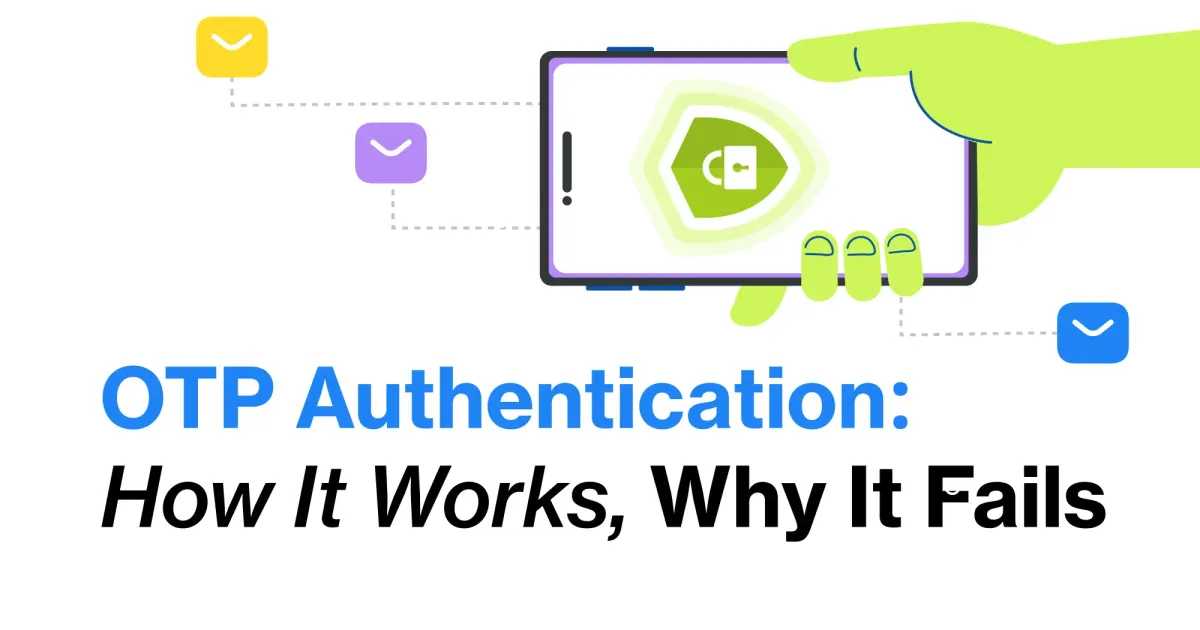
Every login, every payment, every password reset somewhere behind it sits a six-digit code sent to a phone. OTP (one-time passcode) authentication has quietly become the default way businesses verify that the person on the other end is who they say they are. It happens billions of times a day across banking apps, e-commerce checkouts, ride-share logins, and healthcare portals, and most of the time, nobody thinks about it at all.
That's exactly the problem. OTP has become so invisible, so assumed, that most platforms treat it as a solved problem rather than a piece of critical infrastructure. It's also the part of the login flow most likely to break. When it does, the result isn't a minor bug; it's a customer locked out of their bank account, a fraud attempt that slips through, or a support queue full of "I never got my code" tickets.
This article walks through how OTP authentication actually works under the hood, the specific points in that chain where it quietly fails, why those failures matter more than most teams realize, and what a genuinely reliable setup requires.
Why OTP Became the Default in the First Place
Before diving into how it works, it's worth understanding why OTP won out over the alternatives. Passwords alone were never enough; they get reused, phished, and leaked in data breaches by the billions. Businesses needed a second factor that didn't require installing new hardware, didn't assume every user owned a smartphone capable of running an authenticator app, and worked in virtually every country without extra setup.
SMS-delivered OTP checked every box: nearly universal phone number coverage, no app download required, and a familiar user experience that doesn't need explaining. That ubiquity is exactly why it spread so fast across fintech, e-commerce, healthcare, gaming, and telecom, and exactly why so many platforms never questioned whether the delivery layer underneath it was actually reliable.
How OTP Authentication Works
At a high level, OTP authentication is a five-step handshake between your platform and your user's phone:
- Trigger. The user attempts to log in, complete a payment, or reset a password. This action tells your system that verification is required before the action can proceed.
- Generation. Your system (or your SMS provider's platform) generates a random, time-limited code — usually 4 to 8 digits. This code is typically stored server-side, tied to that specific session or transaction, and given an expiry window. Under the hood, most OTP systems use one of two standard algorithms: HOTP (HMAC-based One-Time Password), which generates a code based on a counter that increments with each use, or TOTP (Time-based One-Time Password), which generates a code based on the current time, typically refreshing every 30 seconds. SMS-delivered OTPs are usually a variation of the time-based approach, generated fresh for each request rather than pulled from a rotating sequence.
- Delivery. The code is sent to the user, most commonly via SMS, though email and authenticator apps are also used. This is the step that involves the most moving parts: carrier networks, routing decisions, and delivery infrastructure that sits entirely outside your own platform's control.
- Entry. The user reads the code and enters it back into your platform within a set time window, typically 30 seconds to 10 minutes depending on the use case and risk tolerance.
- Verification. Your system checks the entered code against the one it generated, confirms it hasn't expired, and either grants access or rejects the attempt.
On paper, that's it: five steps, a few seconds, done. In practice, step 3 is where almost everything that goes wrong actually happens. Everything before delivery is code your team controls. Everything after delivery depends on infrastructure, carrier relationships, and routing decisions that most engineering teams never look at closely until something breaks.
Where OTP Delivery Actually Fails
1. Carrier filtering and spam blocking
Mobile carriers run automated filters to catch bulk and spam traffic, and those filters don't distinguish neatly between "unwanted marketing blast" and "legitimate one-time passcode." If your SMS provider's sender ID or messaging pattern looks even slightly like the traffic carriers filter high volume from an unfamiliar number, generic templated content, no history with that carrier — your OTP can be delayed, throttled, or dropped entirely. The worst part is that this usually happens with zero visibility for your team until users start complaining. Your dashboard might show "sent," while the carrier silently filtered it three networks downstream.
2. Single-route dependency
Many platforms send OTPs through a single SMS route with no failover, often because it's the cheapest option quoted by their provider. If that route degrades congestion, an operator dispute, a temporary block, a change in local regulation every OTP behind it stalls at the same time, for every user in that region. This is one of the biggest hidden risks in how A2P SMS pricing and routing decisions get made: the cheapest route is rarely the most reliable one, and the savings evaporate the first time a whole region can't log in during a peak traffic period.
3. SIM swap and number porting
A code sent to "the user's number" assumes that number still belongs to the user. SIM-swap fraud and number porting exploit exactly that assumption an attacker convinces a carrier (or bribes an insider) to transfer a victim's number to a new SIM, and every OTP meant for that person now arrives on the attacker's device instead. This isn't a theoretical risk; it's a well-documented fraud vector that has been used against high-value targets ranging from cryptocurrency holders to corporate executives. NIST's digital identity guidelines have flagged SMS-based OTP as a "restricted" authenticator for exactly this reason, worth knowing if you're weighing OTP against other verification methods for higher-risk use cases.
4. No fallback channel
When SMS delivery fails, what's the backup? Many platforms don't have one. A single failed delivery becomes a dead end: the user can't log in, can't get a new code without waiting through the same failure point again, and ends up calling support or abandoning the transaction altogether. For an e-commerce checkout, that's a lost sale. For a banking app, it's a locked-out customer during exactly the moment they needed access most.
5. Poor visibility into delivery status
If your platform doesn't know whether an OTP was actually delivered not just "sent" you can't tell the difference between "the user hasn't checked their phone yet" and "the message never arrived." That gap is where most OTP-related support tickets originate, and it's also where support teams waste the most time, since they lack data to diagnose the root cause. This is closely tied to route quality — see our guide on direct routes vs grey routes for why some providers simply can't offer real delivery confirmation, no matter how good their dashboard looks.
6. Regional and time-zone blind spots
A route that performs well in Western Europe during business hours can behave completely differently at 2 a.m. in Southeast Asia, where different carriers, different regulations, and different peak-traffic windows apply. Teams that test OTP delivery only in their home market often discover these gaps only after expanding internationally, usually during a launch, which is the worst possible time to find out.
OTP vs. Other Authentication Methods
It's worth being clear-eyed about where OTP fits relative to the alternatives, since "just switch to an authenticator app" is often thrown out as a simple fix when it isn't always practical.
- Authenticator apps (TOTP) generate codes locally on the device, removing the SMS delivery step entirely, which eliminates carrier filtering and interception risk. The tradeoff is adoption: they require the user to install an app in advance, which many consumer platforms can't assume, especially for first-time or infrequent users.
- Email OTP avoids carrier issues but introduces its own delivery risk (spam filters, delayed inbox sync) and is generally slower for time-sensitive actions like payment confirmation.
- Push notifications from a dedicated app offer a smoother experience but, again, require the app to already be installed, not viable for a first login or a guest checkout.
- Biometric and hardware keys offer the strongest security but the highest friction and cost, and are typically reserved for high-privilege accounts rather than everyday consumer logins.
SMS OTP remains the most universally accessible option precisely because it requires nothing from the user beyond having a phone number, which is exactly why the delivery infrastructure behind it deserves far more scrutiny than it usually gets.
What Reliable OTP Delivery Actually Requires
- Redundant, direct-carrier routing so a single route issue doesn't take down verification for an entire region. See our SMS for Fintech infrastructure guide for what this looks like in practice at the infrastructure level.
- Delivery confirmation, in real time - knowing a code was delivered (not just submitted to a carrier) changes how you handle a support ticket, a retry, or a fraud investigation.
- A fallback channel - email or voice call as a second option when SMS delivery stalls, so a single point of failure doesn't become a dead end for the user.
- Verified sender identity — reduces the odds of carrier filtering and gives users a recognizable, trustworthy sender rather than a random, unfamiliar number that looks exactly like the spam they've learned to ignore.
- Short, well-tuned expiry windows - long enough for a real user to act without frustration, short enough to limit a stolen or intercepted code's usefulness.
- Regional testing, not just home-market testing validating delivery performance in every market you actually serve, not just the one your team happens to sit in.
The Real Cost of Getting This Wrong
A failed OTP isn't a UX inconvenience; it's a blocked transaction, a frustrated customer, and in fintech specifically, a compliance question about why a security control didn't perform reliably when it mattered. Regulators increasingly expect financial platforms to demonstrate that their authentication infrastructure actually works as designed, not just that it exists on paper. If you're in banking or fintech, our piece on OTP verification for fintech and banks goes deeper on the compliance side of this.
The businesses that treat OTP delivery as critical infrastructure, not a CPaaS or SMS API afterthought bundled in with a dozen other channels, are the ones that don't find out about a routing problem from their support queue. They find out from a dashboard, hours or days before it becomes a customer-facing issue.
Common Myths About OTP Delivery
A few assumptions come up repeatedly in conversations with engineering and product teams, and most of them don't hold up.
"Our SMS provider guarantees delivery." No provider can guarantee delivery in the strict sense; they can only guarantee that a message was successfully handed off to a carrier. What happens after that handoff depends on the carrier's own filtering, network conditions, and handset status, none of which any SMS provider directly controls. What a good provider can guarantee is visibility: telling you, in real time, what actually happened after handoff.
"More expensive always means more reliable." Not necessarily — but it's directionally true more often than not, because reliable delivery requires direct carrier relationships, redundant routing, and ongoing compliance work that costs money to maintain. The right question isn't "why does this cost more," it's "what specifically am I getting for the difference?"
"If it worked in testing, it'll work in production." Testing usually happens with a handful of numbers, on your team's home network, during business hours. Production traffic hits every carrier, every network condition, and every time zone your user base actually lives in. A route that performs perfectly in a QA environment can behave very differently at 3 a.m. across a dozen different countries.
"Switching providers is too disruptive to consider." Migrating OTP delivery is usually far less disruptive than teams expect; most providers offer parallel run periods where both old and new routes handle live traffic simultaneously, letting you compare real delivery data before fully cutting over.
"Two-factor authentication is basically interchangeable — SMS, app, email, doesn't matter much." It matters more than it seems. Each method has a different threat model, a different failure mode, and a different user experience cost. Treating them as interchangeable is how teams end up defaulting to whichever one was easiest to implement, rather than the one that actually fits their risk profile.
How to Test Whether Your Current Setup Actually Holds Up
Most teams don't find out their OTP delivery has a problem until it's already affecting real users. A more proactive approach:
- Run delivery tests across every region you serve, not just your home market, and do it at different times of day, including hours your own team is asleep.
- Track delivered-vs-sent rates over time, not just on the day you set things up. Carrier relationships and route quality can degrade gradually, and a setup that worked well six months ago may have quietly gotten worse.
- Simulate a route failure and confirm your fallback channel actually activates the way you expect, rather than assuming it will.
- Audit your sender ID reputation periodically — a sender ID that carriers trusted a year ago can lose that trust if traffic patterns or content changed.
- Ask your provider for real delivery data, broken down by country and carrier, not just an aggregate percentage that hides regional weak points.
If you're evaluating or re-evaluating an OTP provider, a short list of direct questions goes a long way:
- Can they name the exact route type — direct or grey used for each country you operate in?
- Do they provide real-time delivered/failed status, or only "sent" confirmation?
- Is there a documented fallback channel if SMS delivery fails?
- What's their historical delivery rate by region, and can they show it — not just claim it?
- How is sender identity verified, and does that verification differ by market?
Providers who can answer all five clearly and specifically are worth far more than the one quoting the lowest per-message rate.
Frequently Asked Questions
What is OTP authentication?
OTP (one-time passcode) authentication is a security method that sends a temporary, single-use code to a user, typically via SMS, email, or an authenticator app — which the user must enter to verify their identity before completing an action like logging in or confirming a payment.
Is SMS OTP secure?
It's reasonably secure for most everyday use cases, but it has known weaknesses — primarily SIM-swap fraud and carrier-level interception risk. For high-privilege accounts or high-value transactions, pairing SMS OTP with an additional factor, or using an authenticator app instead, is generally considered a stronger practice.
Why didn't I receive my OTP code?
The most common causes are carrier filtering, a degraded or congested SMS route, an incorrect or outdated phone number on file, or the code simply expiring before it arrived due to a slow route. If this happens repeatedly rather than occasionally, it usually points to a provider or routing issue rather than a one-off network hiccup.
How long should an OTP code remain valid?
Most platforms use a window between 30 seconds and 10 minutes, depending on the sensitivity of the action. Shorter windows are more secure but riskier for user experience if delivery is even slightly delayed, which is exactly why reliable, fast delivery matters as much as the expiry window itself.
What's the difference between HOTP and TOTP?
HOTP generates codes based on an incrementing counter, while TOTP generates codes based on the current time, typically refreshing every 30 seconds. TOTP is more common in authenticator apps because it doesn't require the server and device to stay perfectly in sync on a counter value.
Can OTP codes be intercepted?
Yes, though it requires specific conditions: SIM-swap fraud, SS7 network vulnerabilities, or malware on the user's device are the primary vectors. These are real but relatively rare compared to the much more common failure mode of simple non-delivery.
Should we use SMS OTP or an authenticator app?
It depends on your user base and risk profile. SMS OTP wins on accessibility; it needs nothing but a phone number. Authenticator apps win on security but require the user to have already installed one, which isn't realistic for every first-time login or guest transaction. Many platforms end up offering both, defaulting to SMS with an authenticator app as an optional upgrade.
How do I know if my SMS provider's routes are reliable?
Ask directly for delivered-vs-sent data broken down by country and carrier, ask what route type is used for each destination, and ask what fallback exists if a route degrades. A provider that can answer specifically, not just point to an aggregate uptime number, is generally the more trustworthy option.
Conclusion:
OTP authentication looks simple from the outside: a code goes out, a code comes back, access is granted. The complexity lives entirely in the delivery layer, and that's exactly where most platforms have the least visibility and the least control. Treating that layer as an afterthought is how a routing decision made to save a fraction of a cent per message turns into a fraud incident, a regulatory question, or a support queue full of locked-out customers.
Yootelco delivers OTP authentication built on direct, redundant carrier routes with real-time delivery visibility designed for the moments verification can't afford to fail.